


How Porcelain Slabs Are Made
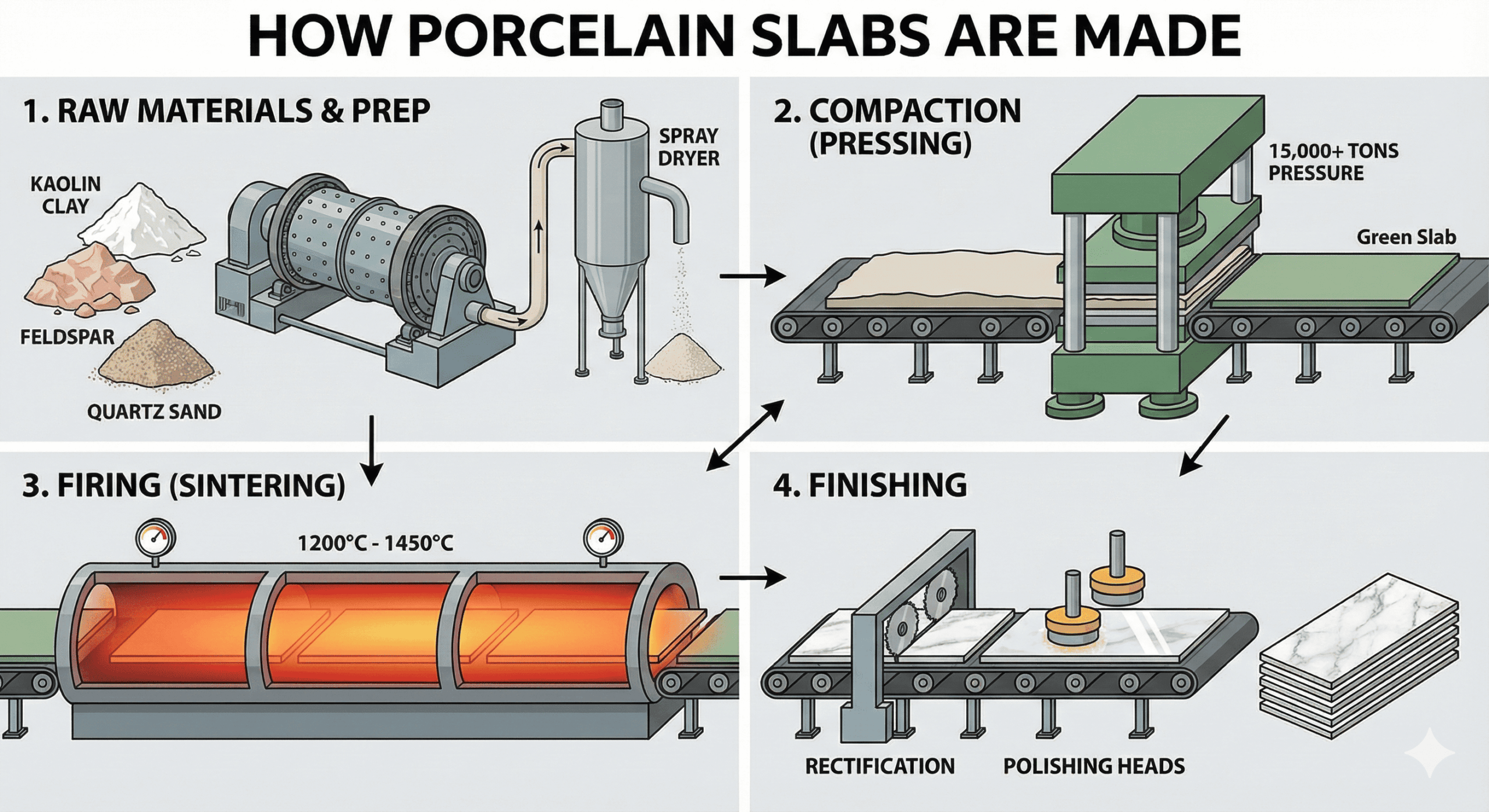
Table of content
How Porcelain Slabs Are Made
In the world of modern architecture and interior design, porcelain slabs have emerged as a revolutionary material. Praised for their massive size, incredible durability, and ability to mimic natural stone, they are quickly becoming the top choice for kitchen countertops, flooring, and wall cladding.
But what exactly goes into creating these massive surfaces? The secret lies in a sophisticated manufacturing process that combines raw natural minerals with cutting-edge technology.
Here is a step-by-step look at the manufacturing process of porcelain slabs.
1. Sourcing the Raw Materials
The quality of porcelain slabs begins with carefully selected natural raw materials. Unlike standard ceramic tiles, porcelain tiles manufacturing requires high-purity minerals with controlled chemical compositions.
The specific “recipe” usually includes a precise blend of:
- Kaolin Clay (China Clay): Provides plasticity and structure.
- Feldspar: Acts as a flux to lower the melting temperature during firing.
- Silica Sand: Adds strength and structural integrity.
- Mineral Oxides: Used for pigmentation and creating the base color.
These raw materials are precisely measured to ensure low porosity, high density, and superior technical performance in the final porcelain slab.
2. Atomization (Mixing and Drying)
Once mined, the raw materials are transported to the manufacturing plant. Here, they are mixed with water and ground inside massive mills until they form a liquid mixture called “slip.”
To prepare this mixture for pressing, it must be dried out. The ceramic slurry is then processed through spray drying towers, where hot air evaporates the moisture. This step transforms the slurry into a fine, free-flowing granulated powder.
Why Spray Drying Matters:
- Ensures optimal moisture content
- Improves compaction during pressing
- Prevents internal defects in large-format porcelain slabs
This controlled powder is essential for manufacturing large porcelain slabs with uniform density across their entire surface.
3. The Compaction Phase (Pressing)
This is where porcelain slabs differ significantly from standard ceramic tiles. Standard tiles are often pressed in molds. However, to create large format surfaces, manufacturers use a method called continuous compaction.
The atomized powder is spread evenly on a conveyor belt. It is then subjected to immense pressure—often exceeding 400 kg/cm²—using heavy rollers or hydraulic presses. This step removes air pockets and compacts the powder into a dense, cohesive slab body before it is even fired.
4. Digital Decoration and Surface Design
Before the slab enters the kiln, it is a blank canvas. To achieve the luxurious look of Calacatta marble, industrial concrete, or oxidized metal, manufacturers use advanced inkjet printing technology.
This technology allows for:
- Hyper-realistic graphics: Replicating the exact grain of wood or the veins of natural stone.
- Through-body veining: In high-end slabs, the pattern is synchronized with the body of the material so that the design is visible even on the edges.
- Texture application: Special glazes can be applied to create matte, satin, or grip finishes.
5. High-Temperature Firing (Sintering)
The formed and decorated slabs are fired in roller kilns at temperatures reaching 1,200–1,300°C.
What happens during sintering?
At these extreme temperatures, the feldspar and clay fuse together in a process called vitrification. The materials do not just melt; they coalesce into a completely new, incredibly dense material. This makes the slab:
- Non-porous: (Water absorption rate of $<0.5\%$).
- Heat resistant: Capable of withstanding hot pans directly on the surface.
- UV stable: The color will not fade in direct sunlight.
6. Finishing Processes: Polished, Matt, and Structured Surfaces
Once the slabs exit the kiln and cool down, they are extremely hard. Depending on the desired look, they may undergo post-firing surface treatments:
- Polishing: Diamond abrasive pads are used to grind the surface to a mirror-like high gloss.
- Rectification: The edges are cut with precision saws to ensure exact 90-degree angles and specific dimensions, allowing for minimal grout lines during installation.
- Reinforcement: For thinner slabs (such as 3mm or 6mm), a fiberglass mesh may be adhered to the back for added flexibility and safety during transport.
7.Quality Control and Technical Testing
Every batch of porcelain slabs is subjected to strict quality control tests, including:
- Flexural strength testing
- Water absorption measurement
- Surface abrasion resistance
- Chemical and stain resistance
- Dimensional accuracy checks
Only slabs that meet international standards such as ISO, EN, and ASTM are approved for commercial distribution.
Why Choose Porcelain Slabs?
Understanding how they are made highlights why they are superior to many other surface materials. The sintering process essentially mimics the natural formation of stone deep inside the earth—accelerated from millions of years to just a few hours.
The result is a surface that offers the beauty of natural stone with the engineering benefits of man-made consistency: zero maintenance, high hygiene, and unmatched longevity.